
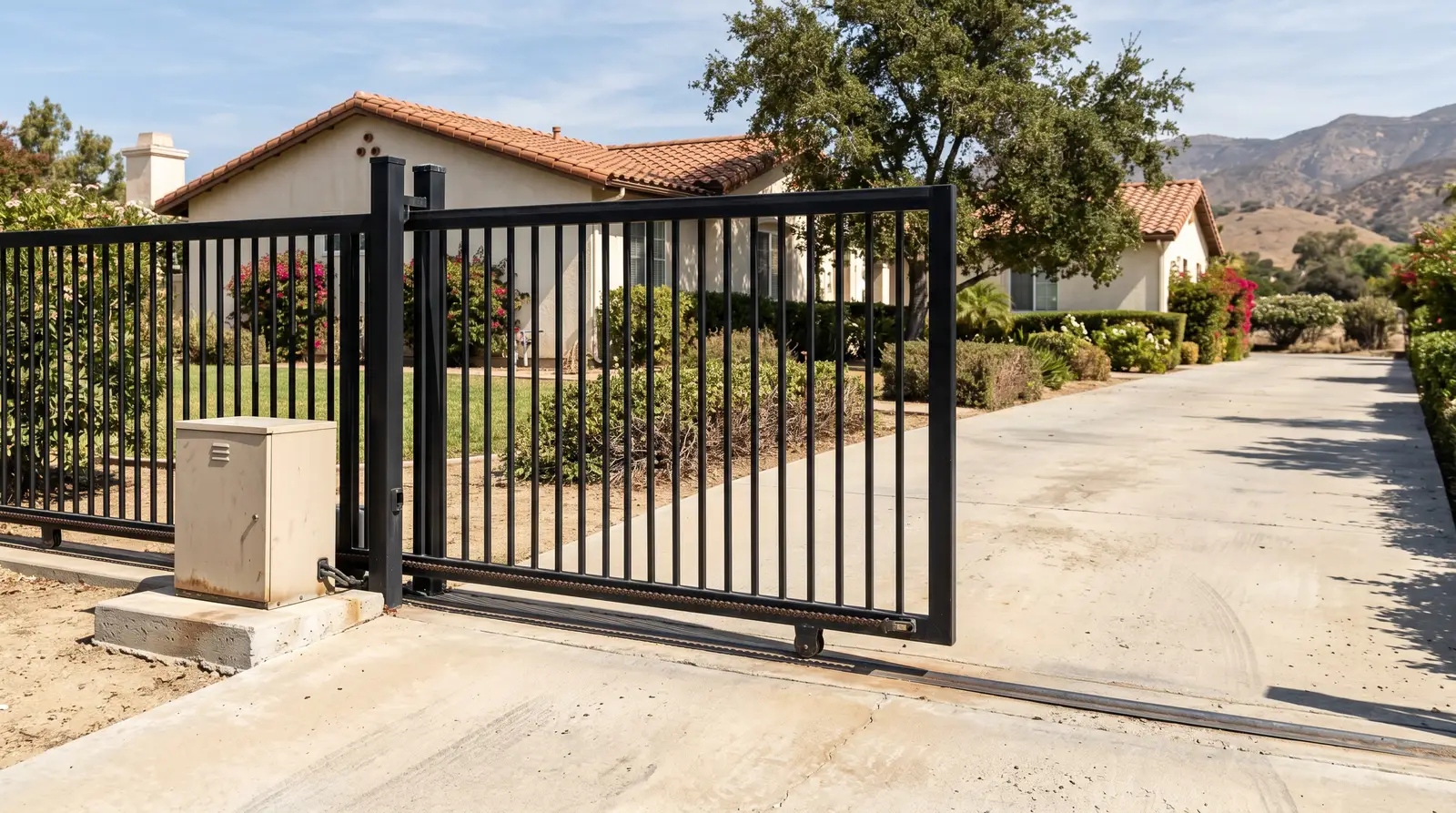
A stuck gate has a talent for bad timing. It strands your car in the driveway before work, or it sits wide open all weekend while you wonder who else has noticed. We have repaired automatic gates across the San Gabriel Valley since 2004, and the truth is that most no-open, no-close calls come down to the same eight causes. Here they are, in roughly the order we check them, along with what is safe to try yourself and where to stop.
Quick safety note before anything else: an automatic gate can weigh several hundred pounds and the operator does not know your hand is in the way unless its safety devices tell it. Never disable or bypass photo eyes, edge sensors, or the operator cover to “get it working.” That is how injuries happen, and it violates the UL 325 safety standard every modern gate is built around.
1. The Gate Has No Power
It sounds obvious, but it leads the list for a reason. Gate operators are usually fed from a breaker that also serves outdoor circuits, and one tripped GFCI from a sprinkler leak or a holiday-light mishap takes the whole gate down.
Try this: check the breaker panel and any outdoor GFCI outlets on the same run, then look for an on/off switch on the operator itself, which sometimes gets flipped by landscapers. If the operator has lights or an LED status display, no lights at all almost always means a supply problem rather than a gate problem.
2. The Battery Backup Is Dead
Since 2019, California SB-969 requires battery backup on newly installed automatic garage door openers, and most quality gate operators offer the same feature. Here is the catch: after a power outage, a worn-out backup battery can leave the operator in a confused half-alive state where it clicks but will not move the gate. Backup batteries typically last 2 to 4 years in our climate, and heat is what kills them.
Try this: if your gate misbehaves right after an outage, restore main power and give it a few hours. If the problem persists, the battery likely needs replacement, which is a quick service visit.
3. Photo Eyes Are Blocked or Out of Alignment
Those little sensors near the bottom of the gate opening are the most common reason a gate opens fine but refuses to close. If the beam between them is interrupted or misaligned, the operator assumes something is in the way and holds the gate open on purpose.
Try this: look for anything in the beam path: a trash bin, an overgrown shrub, a parked bumper, cobwebs, or a sensor knocked crooked by a mower. Wipe the lenses, clear the path, and check for a steady indicator light on each sensor. A blinking light usually means misalignment; gently nudge the sensor until the light goes solid.
4. The Remote, Keypad, or Intercom Is the Problem
Before assuming the gate is broken, make sure the command is actually reaching it. Remote batteries die, keypads corrode, and phone-based entry systems can lose their connection.
Try this: test more than one way of opening the gate. If the keypad works but the remote does not, you have a remote problem, not a gate problem. Fresh batteries fix most remotes; if not, the remote may need reprogramming to the operator. If your gate uses a telephone entry or access control system, a dead phone line or internet outage at the entry panel can also be the culprit.
5. Something Is Binding the Gate Itself
Operators move gates; they do not fix geometry. A sliding gate with debris jammed in the track, flat or seized rollers, or a bent guide post will strain and stall. A swing gate with a sagging hinge drags on the driveway and triggers the operator’s obstruction sensing, which makes it stop and reverse as if it hit something.
Try this: put the operator in manual release mode (your manual shows how) and move the gate by hand. It should glide with light effort. If it grinds, drags, or fights you, the problem is mechanical: track, rollers, hinges, or the gate frame itself. That is a hardware repair, and running the operator against it will burn out the motor.
6. The Limit Switches Have Drifted
Limit settings tell the operator where “fully open” and “fully closed” are. When they drift out of adjustment, you get a gate that stops a foot short, slams the stop post, or reverses at the end of its travel for no visible reason.
Try this: this one is diagnosis-only for most owners. If the gate consistently stops at the wrong spot but otherwise runs smoothly, note exactly where it stops and tell your technician. Adjusting limits is quick work with the right knowledge of your operator model, and guessing at it can make things worse.
7. The Chain, Belt, or Gear Drive Has Worn Out
If you hear the motor running but the gate does not move, the connection between them has failed: a snapped or thrown chain on a slide gate, a stripped drive gear, or a worn clutch. Years of California sun and dust shorten the life of all three, which is one reason we push seasonal upkeep in our gate maintenance guide.
Try this: look for a chain lying on the ground or hanging slack; that diagnosis is free. The repair itself involves tension, alignment, and often replacement parts, so leave it to a technician.
8. Ants, Rodents, and Corroded Wiring
Welcome to Southern California. Ants love the warmth of control boards and can carpet one thoroughly enough to short it out. Rodents chew low-voltage wiring between the operator, keypads, and safety loops. Corrosion works slower but just as surely, especially on coastal-facing installs.
Try this: if you open the control box cover and find it crawling, treat the mound nearby and have the board inspected before powering through. Chewed or corroded wiring shows up as intermittent gremlins: a gate that works most days and fails on others. Intermittent faults are exactly the kind of thing a professional diagnostic finds faster than trial and error.
When to Stop Troubleshooting and Call
A reasonable line: if the fix involves anything beyond clearing obstructions, cleaning sensors, swapping remote batteries, and resetting a breaker, bring in a licensed technician. Gate operators combine line voltage, high spring and gate forces, and safety systems that exist to keep people from being crushed. A repair that defeats one of those protections is worse than no repair.
It is also worth knowing that in California, gate work above $1,000 in combined labor and materials legally requires a licensed contractor, and under Business and Professions Code Section 7031(b) you can recover everything you paid an unlicensed one. Ask for a license number; a legitimate company will not hesitate. Ours is CSLB #974487.
Fix It Once, Then Keep It Fixed
Most of the failures above are preventable. The same visit that repairs your gate can align the photo eyes, tension the chain, lubricate the hardware, test the backup battery, and verify the safety reversing, which is the difference between a gate that fails every summer and one that quietly works for years. Our gate maintenance article covers the schedule we recommend, and pairing the gate with a camera at the approach (see our camera placement guide) means you can see what is happening at the gate without walking out to it.
Gate stuck right now? Call AD Security, Inc. at (626) 421-7250 or request service online. We repair all major gate operator brands, including LiftMaster, DoorKing, and FAAC, throughout Covina, Pasadena, and Southern California.