
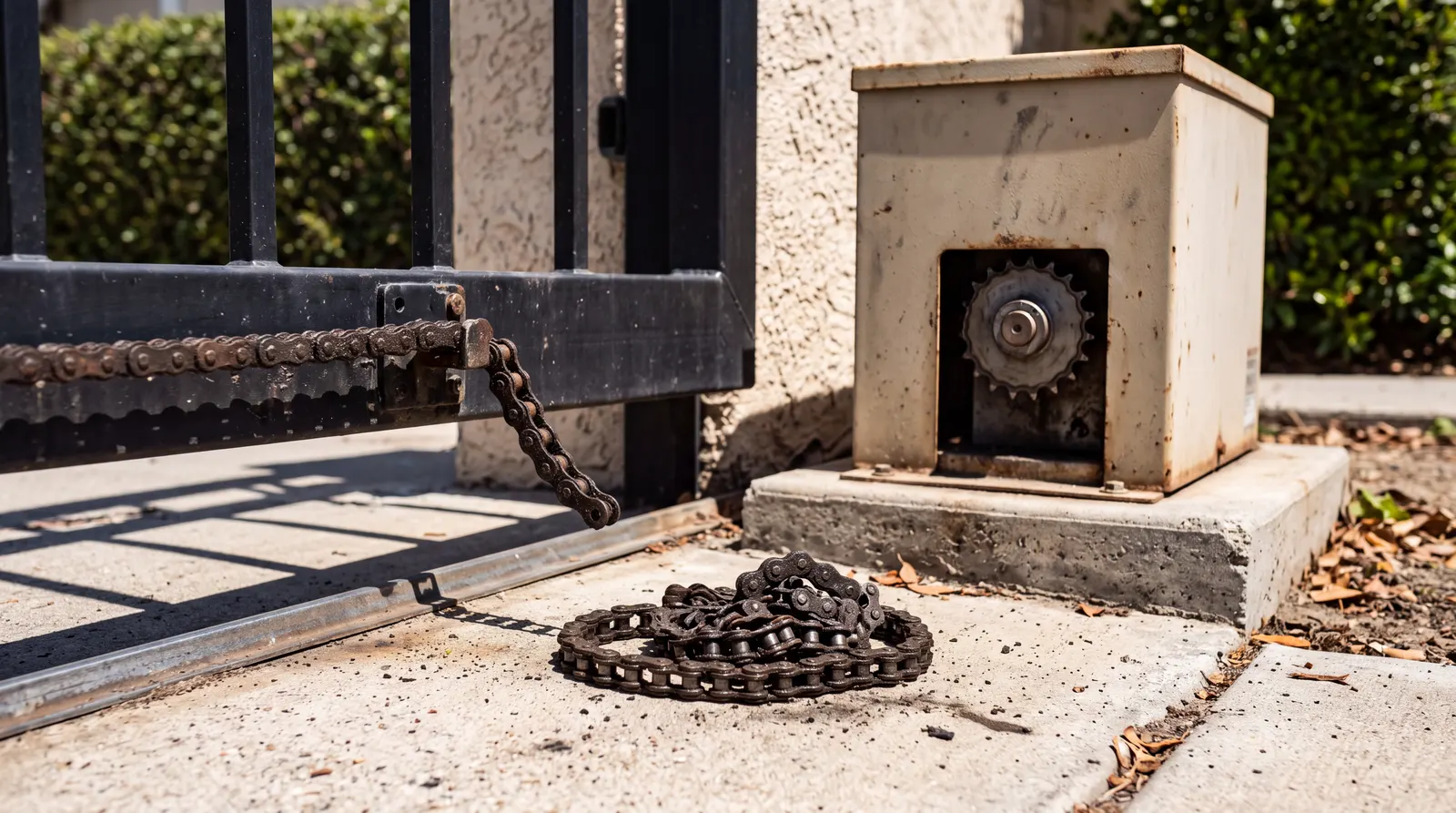
You press the button, the operator hums the way it always does, and the gate does not budge. Oddly, that is good news for the diagnosis. Power, the control board, and the motor are all working. The fault is somewhere in the short chain of parts that turns a spinning motor into a moving gate. We have repaired automatic gates across the San Gabriel Valley since 2004, and these are the seven places that chain breaks.
Two things before you look. First, stop pressing the button. Every extra cycle against a failed drive overheats the motor and chews up whatever is still intact. Second, treat the gate as loose. A gate that is no longer held by its operator may move on its own. A slide gate on a slope can roll and a swing gate can catch the wind, so keep people and cars clear until you know it is secure.
1. Manual Release Was Left On
This is the most common cause and the only free one. Operators have a manual release so the gate can be moved by hand in an outage: a keyed lever, a pin, or on hydraulic operators a bypass valve. If someone used it during a power outage, a delivery, or a landscaping visit and never put it back, the motor spins freely and the gate stays where it is.
Try this: find the release in your manual and take the operator out of manual release. You may need to nudge the gate an inch or two by hand before the drive catches. Then test once. If the gate moves, you are done.
2. A Broken or Thrown Chain (Slide Gates)
Most slide gates are pulled by a chain that runs the length of the gate. A link can snap, the chain can jump off its sprocket, or the bolts holding it to the end of the gate can pull out. You will usually see it: a chain lying on the ground or hanging slack.
Try this: look, and stop there. Never re-thread a chain with the power on, because fingers and sprockets do not mix. A chain also has to be set to the right tension and alignment, and one that jumped once will jump again until the reason is fixed.
3. A Sprocket or Arm Spinning on Its Shaft
The motor and gearbox turn a shaft, and a sprocket or drive arm is fixed to that shaft with a key, a set screw, or a pin. When that small part lets go, the shaft spins inside the sprocket and nothing reaches the gate. These parts often fail after the gate was hit, forced by hand, or run against something in its path, so the part is cheap but the real question is what broke it.
Try this: from a safe distance, watch where the chain leaves the operator, or the arm on a swing gate, while someone presses the button once. If you can hear the gearbox working and the chain or arm does not move at all, that points to a sprocket or arm that has come loose on its shaft. Leave the cover on and tell your technician what you saw.
4. Stripped Gears Inside the Operator
Many operators use plastic or soft-metal gears that are meant to be the weak link, so they fail before something more expensive does. Years of load, a gate that has become heavy to move, or one hard jolt will strip the teeth. The sound is the giveaway: a grinding or ratcheting noise, or a clean motor whir with nothing behind it. Plastic shavings under the operator confirm it.
Try this: nothing, other than describing the sound to your technician. This is an internal repair, and on an older operator it is the point where repair and replacement need an honest comparison.
5. A Slipping Clutch or Belt
Some operators have an adjustable clutch or a drive belt between the motor and the gearbox. When it is worn, glazed, or contaminated with oil, it slips. The motor runs, and the gate creeps, stalls, or only moves if you help it by hand.
Try this: do not tighten the clutch to get the gate moving. On these designs the clutch is part of how the operator limits the force it can put on a person or a car in the gate’s path. Note whether the gate moves with a little help, and leave the adjustment to someone with the manufacturer’s settings.
6. A Disconnected Arm (Swing Gates)
On a swing gate, an arm links the operator to the gate. A bolt or pin can back out, a bracket weld can crack, or on screw-driven arms the internal drive nut can strip, so the motor runs and the arm never extends.
Try this: look at both ends of the arm. A pin lying on the driveway or a bracket pulled away from the gate tells you what happened. Do not try to reconnect an arm that is under load.
7. A Stuck Gate
Sometimes the drive is slipping exactly as designed because the gate cannot move. A seized wheel, a rock in the track, a gate that has come off its track, or a frozen hinge will hold a gate against any operator.
Try this: put the operator in manual release and push the gate by hand. It should move with light effort. If it grinds, drags, or will not move, the repair is in the gate hardware, and running the operator against it will only break the next weakest part. Take the operator out of manual release when you are done.
Secure the Gate While You Wait
A gate that is disconnected from its operator is also not locked by it. A slide gate can be rolled open by hand, which matters if the gate is your security. Until it is repaired, chain and padlock the gate itself to its post, not to the operator, or leave it open on purpose if cars have to get through, and tell anyone else who uses it.
When to Call
Past taking the gate out of manual release, every fix on this list involves parts under tension, pinch points, or force settings that exist to protect people. That is technician work. If the gate is completely dead instead, with no motor sound at all, see what to check when a gate won’t respond to the remote or the button, and for the wider list of causes, why an automatic gate won’t open. Most drive failures trace back to wear that regular service would have caught, which is the case we make in our gate maintenance guide.
Gate stuck right now? Call AD Security, Inc. at (626) 421-7250 or request service online. We repair all major gate operator brands, including LiftMaster, DoorKing, and FAAC, throughout Covina, Pasadena, and Southern California.