
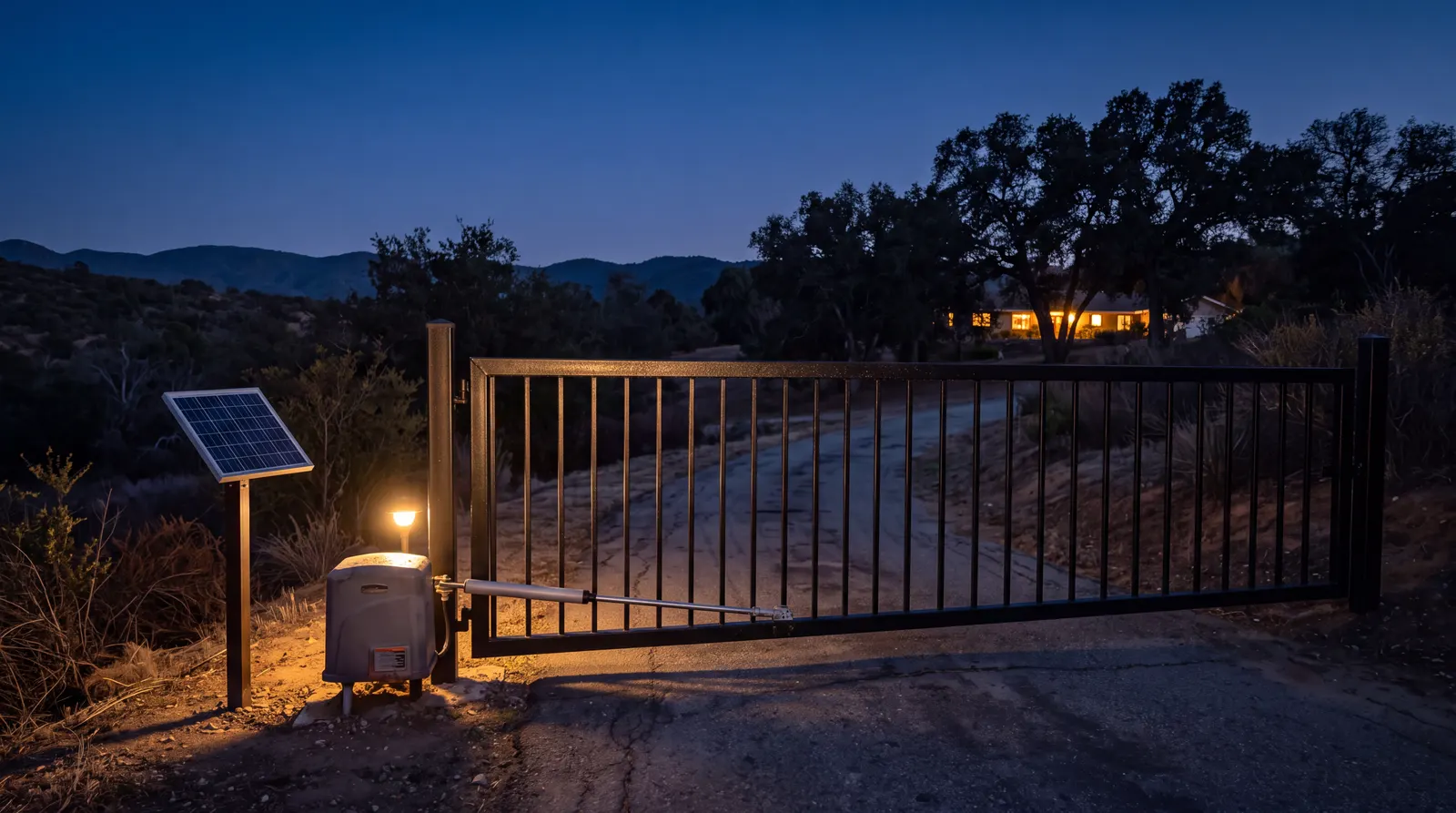
A gate that only misbehaves after dark feels random. It is actually one of the more useful symptoms a gate can give you, because the time-of-day pattern rules out most of the usual suspects and points at a short list: the things that change when the sun goes down. We have repaired automatic gates across the San Gabriel Valley since 2004, and these are the seven causes we find behind “works all day, fails at night,” roughly in the order we check them.
One safety note first. Whatever you find, never disable or bypass photo eyes, edge sensors, or the operator cover to get through the night. Those devices are what keep a several-hundred-pound gate from closing on a person or a car, and the UL 325 safety standard every modern operator is built around depends on them.
1. A Tired Battery on a Solar Gate
This is the classic. A solar gate does not run on its panel. It runs on a battery, and the panel recharges that battery during the day. While the sun is up, the panel props up a weak battery well enough to hide the problem. After sunset the battery is on its own, its voltage sags the moment the motor asks for current, and the operator either refuses to move or quits partway.
Anything else wired to that battery makes it worse. A keypad light, a gate light, or a receiver draws a little power all night, so the battery is at its lowest just before dawn.
Try this: notice when the gate is strongest and weakest. Strong in the late afternoon and dead in the early morning is a battery or charging problem almost every time. Wipe the solar panel, trim anything that has grown up to shade it, and check that its cable is still connected at the control box. If the battery is more than a few years old, plan on replacing it. A battery that fails at night does not recover on its own.
2. Cold Nights
Inland valleys often swing 25 degrees or more between the afternoon and the hours before dawn. Batteries deliver less current when they are cold, grease stiffens, and steel contracts. A gate that is slightly out of adjustment, such as a hinge beginning to sag or a slide gate rubbing a guide roller, can pass in the warm afternoon and bind at 5 a.m. The operator feels the extra resistance, decides it has hit something, and stops or reverses.
Try this: put the operator in manual release (your manual shows how) and move the gate by hand early in the morning, then again in the afternoon. If it is clearly harder to move when it is cold, the problem is in the gate hardware, not the electronics, and it will get worse until the hardware is serviced.
3. Lights That Turn On at Dusk
Two different problems hide here. The first is radio noise. Some LED bulbs and fixtures give off interference in the same band gate remotes use. When the driveway lights switch on, the remote that worked from the street all day suddenly works only from a few feet away.
The second is voltage. If the operator shares a circuit with landscape or driveway lighting, the added load after dark can pull the voltage at the gate down, especially at the end of a long wire run. The gate gets slow, hesitates, or stalls.
Try this: switch the lights off and test again. If the remote’s range comes back, a fixture or bulb near the gate is the culprit, and a better-shielded bulb or a relocated antenna fixes it. A wired keypad that still works at night while the remote does not is the same clue.
4. Dew, Sprinklers, and Spiders on the Photo Eyes
Photo eyes are the small sensors on either side of the opening that tell the operator the path is clear. Overnight is when they get into trouble. Dew fogs the lenses, sprinklers that run before dawn soak them, and spiders rebuild webs across them. With the beam blocked, the gate opens but will not close, which is why you find it standing open in the morning.
Try this: wipe both lenses, clear the webs, and re-aim any sprinkler head that hits a sensor. Each sensor usually has an indicator light. Steady is good, and blinking or dark means the beam is blocked or out of alignment.
5. A Timer or Schedule at Work
In gated communities and on commercial properties, the gate often runs on a schedule. It may be held open during business hours and locked down at night, and some codes, cards, and remotes are only valid during certain hours. If your code works at 2 p.m. and not at 9 p.m., the gate may be fine and your credential may be restricted. A controller clock that was never corrected for daylight saving time shifts the whole schedule by an hour, which produces the same confusion twice a year.
Try this: ask the property manager whether your code or card has hours attached. If you manage the property, check the schedule and the clock in your access control system before assuming the gate is at fault.
6. Moisture in the Control Box
As the temperature drops, moisture condenses inside enclosures. A worn gasket or an unsealed conduit lets damp air in, and a control board that is damp can misbehave until the morning sun dries it out. Near the coast, or anywhere sprinklers hit the cabinet, this turns into corrosion on the terminals.
Try this: look, without touching, for water droplets, rust trails, or white or green crust on the wiring terminals. Do not spray anything on the board. Tell your technician what you saw, because moisture damage is progressive and cheaper to stop early.
7. Low Sun at Sunrise and Sunset
This one is not night exactly, but it is often reported that way. For a short window each day, a low sun can shine straight into a photo eye and blind it, and the gate refuses to close until the sun moves. The window shifts with the seasons, so a gate that behaved all summer starts failing in the fall.
Try this: write down the time it fails. If it is the same time every day and the sun is low and in line with the sensors, shading or re-aiming the sensor, or swapping the two sides, solves it.
What to Tell Your Technician
Time-of-day problems are worth describing well, because the gate will probably work perfectly when the technician arrives at noon. Note what time it fails and what time it recovers, whether the gate is solar, battery, or utility powered, whether the remote fails but the keypad still works, and whether the gate does nothing at all or opens and then refuses to close. Those four answers usually cut the diagnosis in half.
If the gate will not open at all, our guide to the 8 most common reasons an automatic gate won’t open covers the checks that apply at any hour. If the remote and the button both do nothing, start with what to check when a gate won’t respond.
Gate stuck right now? Call AD Security, Inc. at (626) 421-7250 or request service online. We repair all major gate operator brands, including LiftMaster, DoorKing, and FAAC, throughout Covina, Pasadena, and Southern California.